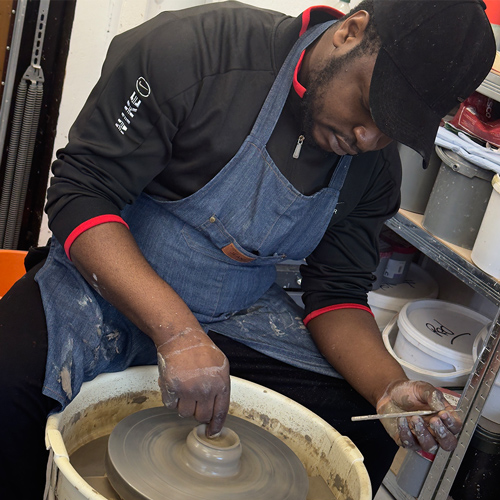
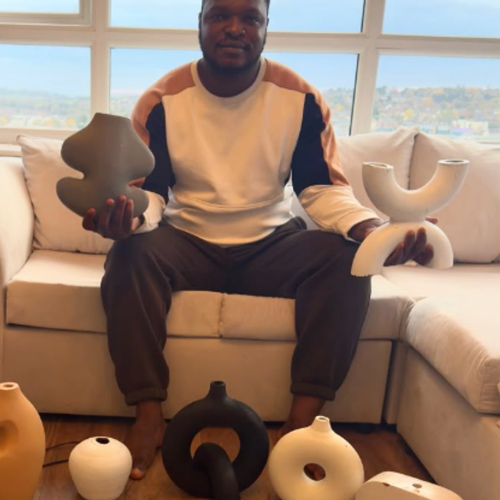
Umar Abdulrasheed’s work explores the quiet conversation between tradition and modernity, shaped by memory, nature, and the inherited knowledge of West African pottery. A Nigerian-born ceramic sculptor based in London and Creative Director of Terrravia Ceramics, he began working with clay in childhood under his grandfather’s guidance—an influence that continues to shape his sensitivity to material and process.
He holds a Bachelor’s degree in Agricultural Science and a Master’s degree in Environmental Management from the University of Hertfordshire, UK. This academic background informs his view of clay as an earth-based material, deepening his focus on texture, material behaviour, and environmental connection. His practice centres on hand-built sculptural vessels and abstract forms, navigating themes of memory, balance, and presence while moving between function and autonomy.
Umar has exhibited nationally and internationally, including a solo exhibition at Orchard Light Gallery, Ilorin, as well as group exhibitions at Espacio Gallery, London; Boomer Gallery; Holy Art Gallery (Brighton); Maidstone Community Art Hub; and Arrival Gallery in the UK. His work has also been shown in Nigeria at the Africa Pottery Exhibition (Lagos), Shao Art in Clay, the Malete Pottery Festival, and the Kwara State Pottery Fair. Umar is a member of the Craft Potters Association (UK) and Friends of Burton at Bideford. In recognition of his practice, Umar received the Artist of the Year Award from the Kwara State University Centre for Entrepreneurship and Craftsmanship in 2014 and again from his department in 2018.
Ultimately, Umar’s practice is an ongoing dialogue with the earth—a pursuit of harmony between heritage and innovation, permanence and fragility, and the past he carries and the future of the evolving language of clay.
Presentation: Ceramic Sculpture and the Conversation Between Land, Agriculture, and Art
Clay and farming share the same starting point: the soil. My background spans both agriculture and ceramic art, and over the years I have come to see these two practices as deeply connected. Farming taught me to read the land, to understand what the earth holds and what it needs. Ceramics gave me a way to speak about it.
My sculptural work grows directly from this dual experience. The forms I create reflect the patterns and pressures I have witnessed on agricultural land: soil erosion, the drying of water sources, and the slow degradation of ground that has been worked too hard for too long. These are not abstract concerns. They are things I have seen firsthand, and they are the conversations I want to bring into the gallery space.
For KArtsCon 2026, I will bring an original ceramic sculpture to serve as the visual centrepiece of my presentation. The piece draws on the textures of cultivated and eroded land, shaped by hand using locally sourced clay. Standing beside it, I will walk attendees through the ideas behind the work: how my agricultural background informs the forms I make, why the material itself carries meaning, and what questions the piece is intended to open up for the viewer. I will also bring raw clay for a short hands-on session, inviting attendees to work with the material themselves. There is no better way to understand what clay holds and what it can say than to feel it in your own hands, and this practical element will give participants a direct experience of the connection between earth, farming, and art that sits at the heart of my practice.