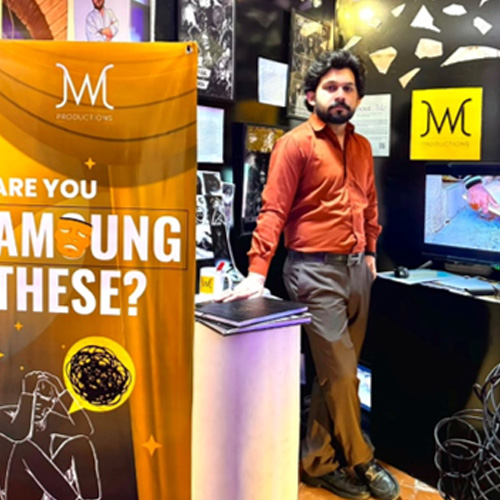
Waleed Yahya Mirza is an emerging graphic designer and visual storyteller whose creative practice focuses on transforming social, psychological, and human-centred issues into meaningful visual experiences. His work combines research-based design thinking with contemporary visual communication, exploring how design can educate, engage, and inspire positive social dialogue.
As a Graphic Design student, Waleed has developed a strong interest in branding, poster design, visual narratives, awareness campaigns, and conceptual storytelling. His projects often investigate themes related to identity, emotional well-being, human behaviour, and social impact, using design as a bridge between information and human experience.
His thesis project, Echoes of Mind, reflects his commitment to addressing mental health awareness through creative practice. By examining panic attacks, anxiety, and subconscious emotional patterns, he seeks to create visual experiences that encourage empathy, understanding, and meaningful conversation. His work emphasizes the power of design not only as an aesthetic discipline but also as a tool for education, advocacy, and emotional connection.
Through continuous experimentation and research, Waleed aims to contribute to the evolving landscape of visual communication by producing work that is socially relevant, emotionally engaging, and capable of creating lasting impact within communities and audiences.
Short Film: Echoes of the Mind – Empowering Silence, Amplifying Voices
“Echoes of the Mind” is a visual storytelling project that explores the hidden psychological realities of panic attacks and anxiety disorders through design, symbolism, and cinematic narrative. In a world where mental health struggles often remain invisible, this project aims to initiate meaningful conversations about emotional well-being, fear, isolation, and the subconscious processes that shape human behaviour.
The project investigates how panic attacks are influenced by accumulated life experiences, emotional memories, subconscious triggers, and learned behavioural patterns developed across different stages of life. Through extensive research, interviews, case studies, and visual experimentation, the work examines the relationship between fear, overthinking, identity formation, and emotional vulnerability. Rather than presenting panic attacks as isolated incidents, the project reveals them as manifestations of deeper psychological echoes that develop over time and silently affect every day experiences.
Alongside the boy’s journey, the film explores the emotional landscape of his family, whose lives revolve around hospital visits, uncertainty, and the constant search for compatible blood donors. Their quiet resilience reveals the strength required to navigate a condition that extends far beyond medical treatment.
A pivotal moment occurs after one of the boy’s routine transfusions. Physically exhausted and emotionally drained, he reflects not on what he wishes to become, but on what he hopes to keep—his chance to continue living, learning, and dreaming. This intimate realization forms the emotional heart of the film, inviting viewers into a reality that often remains unseen.
Through a visually driven narrative, the film presents Thalassemia through the eyes of a child, transforming personal experience into a shared human story. Rather than offering answers, it opens a space for reflection, empathy, and dialogue. By bringing hidden struggles into view, the film encourages audiences to look beyond the illness and connect with the hopes, fears, and aspirations of those whose lives depend on the compassion and support of others.