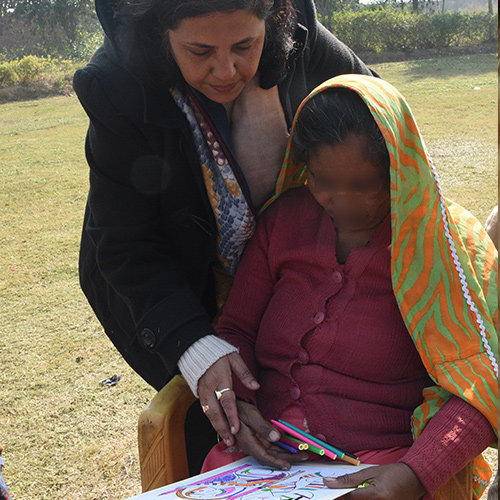
Sumita Chauhan is a visual artist and an independent researcher working at the intersection of art, technology and community wellbeing, with a special focus on older adults with dementia. She is also founder member of a charitable organisation, PGAI, and co-director of an art gallery, Gallery ONKAF, in New Delhi, India. She finished her PhD at the School of Engineering and Digital Arts, University of Kent, Canterbury. A graduate from New Delhi, India, she completed her MA in Fine Art at the Kent Institute of Art and Design (KIAD) and an MPhil in Digital Art at the University of Kent. She has exhibited internationally and been a resident artist in Finland, Taiwan and the UK.
Sumita designs and develops projects with the main intention of facilitating the growing awareness of the benefits of art for mental health. New technological processes challenge her and she tries to incorporate the same in her works and the workshops she conducts. For the last 15 years, she has worked with different groups and organizations in India and the UK. Also made presentations at international conferences and published papers relating to her research. She was awarded a Fellowship of the Royal Society of Arts for her practice-based research involving people with dementia.
Presentation: Photography and visual transformation using a smartphone camera: a creative project for older adults
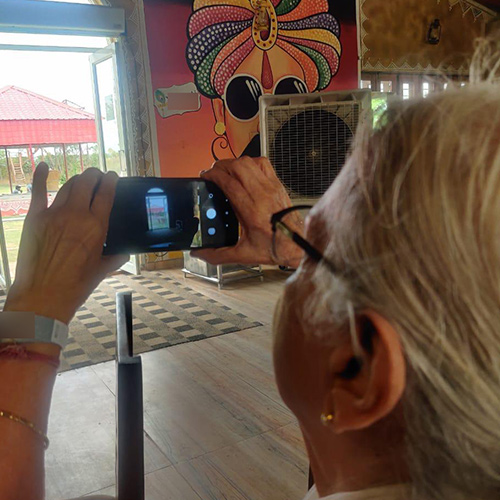
A photograph captures and preserves a specific moment of our lives, allowing it to be revisited and reviewed afterwards. The act of capturing using a camera is an enriching experience and it is considered an expressive art form and a valuable tool for documentation and engagement. The ubiquitous mobile phone camera has transformed photography, combining it with communication and creativity. With the increasing accessibility of smartphone technology, a photography project, “Within the Surroundings – a photo study,” was developed for older adults, including people with dementia. It was centred on using mobile phone cameras and simple image manipulation applications available on devices, mainly to provide them a creative outlet and at the same time, cognitive engagement.
This project was designed in two stages for participants who are 65 years and above, ensuring ease of use with guidance. Although the project is ongoing, this paper presents the key findings based on the works of 38 participants who successfully completed the tasks. In the first stage, they had to capture a minimum number of ten photos of their immediate surroundings, keeping in mind the purpose of promoting their mindfulness and observation skills. In the next phase, they had to select one photo and transform it digitally by adding effects or filters or by adjusting colours or brightness. A study was carried out simultaneously to find out what the experience of participants was while they engaged with a mobile phone device to take a snapshot. Furthermore, did the digital manipulation of their photos alter or maintain the visual content for them?
Keywords: smartphone use, mobile phone camera, photography, digital manipulation, active engagement, older adults.